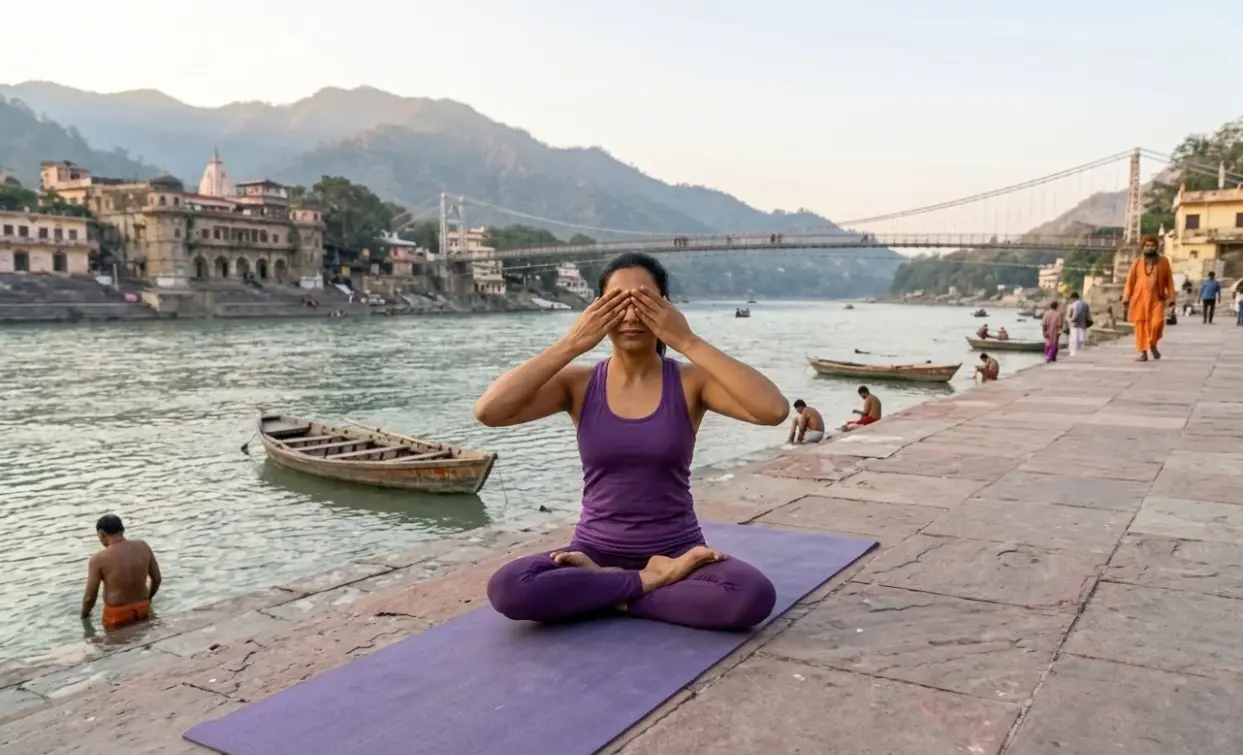
Do you want to naturally improve your eyesight or learn if simple eye exercises can help reduce your dependence on glasses? Yoga offers solutions to many of these questions. Regularly practicing specific Yoga poses (asanas) designed for the eyes can be very beneficial.These yoga exercises are thought to help regulate eye pressure and strengthen the optic nerves. Even simple techniques, like rapid blinking, can quickly relieve the strain caused by long hours on electronic devices, leaving your eyes healthier and stronger. Regularly practicing these exercises helps your eyes relax and function better overall. Before you start, always splash your eyes with cold water a few times. And remember, keep your head and spine straight during all the movements.
- Glasses and eyesight: Spectacles and contact lenses improve vision but do not cure poor eyesight; overuse may worsen dependency.
- Causes of poor vision: Bad/artificial lighting, excessive screen use, poor diet, long office hours, stress, toxins, and aging .
- Diet and lifestyle: A simple, healthy diet—avoiding oily, spicy, processed, and junk foods—supports eye health. A vegetarian or reduced non-vegetarian diet is recommended.
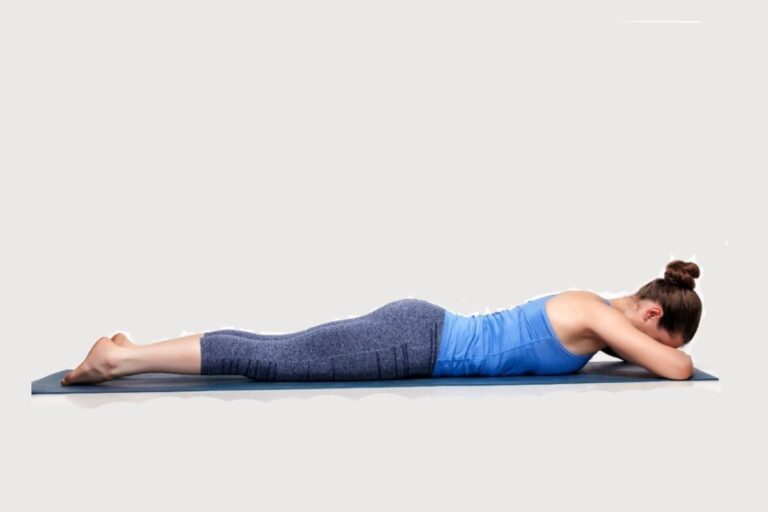
- Reading habits: Reading itself doesn’t harm eyes if done with relaxation and good posture. Tension, however, can cause strain. Relaxation techniques like shashankasana help.
- Reducing glasses use: Wear glasses only when necessary; avoid them during leisure to help eyes function naturally.
Natural practices: Walking barefoot on natural surfaces (grass, sand, earth) and sunbathing with closed eyes at sunrise or sunset are believed to relax and benefit the eyes.
Eye exercises: Eye disorders today, excluding conditions like glaucoma, trachoma, and cataracts, are often due to functional defects in the ocular muscles, which are made worse by chronic mental and emotional tension.
Simple eye exercises can help relieve problems caused by these muscle defects, such as short-sightedness, long-sightedness, presbyopia, and squint.
For these exercises to work, you must practice them regularly with patience and perseverance. Don’t expect instant results; it takes time—a few months or more—to see noticeable progress, as the eyes took time to become defective. However, with consistent practice, improvement is possible and has helped many people who adopted a yogic lifestyle to gradually reduce the strength of their corrective lenses.
Preparation:Splashing cold water on your closed eyes about 10 times before you begin stimulates blood flow and tones your eyes for the exercises
Contra-indications: If you have a serious eye condition like glaucoma, cataracts, trachoma, retinal detachment, thrombosis (clotting in the eye), iritis, keratitis, or conjunctivitis, you should consult an eye specialist before doing any yoga practices. Specifically, you must avoid inverted poses and the cleansing technique kunjal kriya while the condition is active. However, adopting a yogic lifestyle and a simple vegetarian diet may be very helpful.
Practice notes
- Perform the eye exercises in the order given, completing the full sequence once in the morning and/or once in the evening.
- The most crucial element of practice is to stay completely relaxed and avoid straining, as this can cause eye fatigue. Keep your facial muscles, eyebrows, and eyelids loose.
- Rest your eyes for at least 30 seconds after each exercise by closing them. You can use the practice of palming during this rest.
- Do not wear your glasses while doing the exercises.
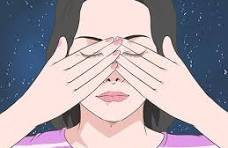
Exercise I: Palming
- Sit quietly with your eyes closed and take a few deep breaths to relax.
- Rub the palms of your hands vigorously until they become warm and place them gently over your eyelids.
- Feel the warmth of the palms being transferred onto the eyes and the eye muscles. You will feel instant relaxation.
- Keep your eyes closed, lower your hands and feel the dryness fade away gradually.
- Once again rub the palms and repeat the process at least three times
Benefits: Palming relaxes and revitalizes your eye muscles and stimulates the circulation of the aqueous humor (the liquid between the cornea and lens), which helps in correcting defective vision
Practice note: The benefits are enhanced if the exercise is practised in front of the rising or setting sun. Be aware of the warmth and light on the closed lids. Never look directly at the sun, except for a few initial moments when it is just rising or when it is about to set.
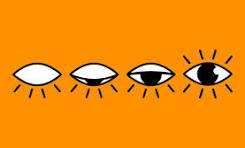
Exercise 2: Blinking
- Sit comfortably with your eyes open.
- Blink around 10 times very quickly.
- Close your eyes and relax for 20 seconds while taking your attention to your breath.
- Repeat this exercise about five times
Benefits: Irregular and unnatural blinking often occurs in people with poor eyesight due to chronic eye tension. This exercise helps make blinking spontaneous again, which relaxes the eye muscles.”
SIDEWAYS VIEWING
Exercise 3: Sideways viewing
Start Position: Sit up straight with your legs extended in front of you.
Arm Position: Raise your straight arms out to the sides, level with your shoulders. Form a loose fist with your hands and point your thumbs up
- Check: Your thumbs should be visible in your peripheral vision without moving your head. If they aren’t, move your arms slightly forward until you can see them.
Head and Eye Focus: Keep your head and spine straight, fixed, and facing forward. Look at a fixed point directly in front of you at eye level.
Movement Cycle: Without moving your head, shift your eye focus between the following points, one after the other:
- Left thumb
- Space between the eyebrows (Bhrumadhya)
- Right thumb
- Space between the eyebrows
- Left thumb
Repetitions: Repeat this full cycle 10 times.
Rest: When done, close your eyes and rest. You may perform palming (covering your closed eyes with your palms) several times.
Breathing: Inhale in the neutral position. Exhale while looking to the sides. Inhale and come to the centre.
Benefits: Sideways viewing relaxes the tension of the muscles strained by constant reading and close work. It also prevents and corrects squint.
Practice note: If the arms become tired they should be supported on two stools.
Check out our 200 hour yoga teacher training course in rishikesh
FRONT AND SIDEWAYS VIEWING
Exercise 4: Front and sideways viewing
- Maintain the same body position as in exercise 3, but place the left fist on the left knee so that the thumb points upward.
- Hold the right. thumb to the right of the body so that it points upward.
- Without moving the head, focus the eyes on the left thumb, then on the right thumb and then return to the left thumb.
- Repeat this process 10 times, then rest and close your eyes.
- Repeat the same procedure on the left side of the body .
- Keep the head and spine straight throughout. Finally, close and rest the eyes.
- Palming may be performed several times.
Breathing:
- Inhale in the neutral position.
- Exhale while looking forward.
- Inhale while looking to the side.
Benefits: Front and sideways viewing improves coordination of the medial and lateral muscles of the eyeball.
UP AND DOWN VIEWING
Exercise 5: Up and down viewing
- Maintain the same position as in exercise 4.
- Place both fists on the knees with both thumbs pointing upward.
- Keeping the arms straight, slowly raise the left thumb while following the motion of the thumb with the eyes.
- Once the thumb is raised to the maximum, slowly return to the starting position, all the time keeping the eyes focused on the thumb without moving the head.
- Practice the same movement with the right thumb.
- Repeat 10 times with each thumb.
- Keep the head and spine straight throughout.
- Finally, close and rest the eyes.
- Palming may be performed several times.
Breathing:
- Inhale while raising the eyes.
- Exhale while lowering the eyes.
Benefits: Up and down viewing balances the upper and lower eyeball muscles.
ROTATIONAL VIEWING
Exercise 6: Rotational viewing
- Maintain the same body position as in exercise 5.
- Place the right hand on the right knee.
- Hold the left fist above the left leg with the left thumb pointing upward and the elbow straight.
- Make a large circular movement with the left arm to the left, then upward, curving to the right, and finally returning to the starting position.
- Keep the eyes focused on the thumb without moving the head.
- Perform 10 times clockwise and then 10 times anti clockwise. Repeat with the right thumb.
- Keep the head and spine straight throughout.
- Finally, close and rest the eyes.
- Palming may be performed several times.
Breathing:
- Inhale while completing the upper arc of the circle.
- Exhale while completing the lower arc.
- The breath should be smooth and synchronized with the forming of a perfect circle.
Benefits: Rotational viewing improves the coordinated activities of all the eye muscles.
PRELIMINARY NASIKAGRA DRISHTI
Exercise 7: Preliminary Nasikagra Drishti (preliminary nosetip gazing)
- Sit with the legs straight in front or in a cross-legged pose.
- Hold the left arm straight directly in front of the nose.
- Make a fist with the left hand, keeping the thumb pointing upward.
- Focus both eyes on the tip of the thumb.
- Bend the arm and slowly bring the thumb to the nosetip, keeping the eyes focused on the tip of the thumb.
- Remain for a few seconds with the thumb held at the nosetip and the eyes focused there.
- Slowly straighten the arm, continuing to gaze at the thumb tip.
- This is one round.
- Practice 10 rounds.
- Keep the head and spine straight throughout.
- Finally, close and rest the eyes.
- Palming may be performed several times.
Breathing: Inhale as the thumb is drawn towards the nose. Exhale as the arm is straightened.
Benefits: This exercise improves the accommodating and focusing power of the eye muscles.
Exercise 8: Near and distant viewing
- Stand or sit at an open window, preferably with a clear view of the horizon, with the anns by the sides.
- Focus the eyes on the nosetip, nasikagra drishti, for 5 seconds.
- Then focus on a distant object on the horizon for 5 seconds.
- Repeat this process 10 times.
- Close your eyes and relax.
- Palming may be performed at this time.
Breathing: Inhale during near viewing. Exhale during distant viewing.
Benefits: Same as for Exercise 7, but the range of movements in these eye muscles is further increased.
Practice note: Lie in shavasana for a few minutes after completing all 8 exercises.
learn to know more about yoga so you can join yoga teacher training in rishikesh