Aerial Yoga Teacher Training in Rishikesh
(10 Days / 100 Hours)
Course Duration: 10 Days.
Ishavasyam Yoga School offers a 10 Days / 100 Hours Aerial Yoga Teacher Training Course in Rishikesh, India, designed for serious practitioners and aspiring teachers seeking authentic, safe, and holistic aerial yoga education. This program is structured to deliver depth, precision, and practical teaching ability within a focused short-term format, without compromising yogic integrity.
Ishavasyam Yoga School is the first and only school to provide holistic aerial yoga education from both the classical yoga and aerial science perspectives. Aerial yoga here is not treated as a fitness trend or acrobatic novelty. It is taught as a yogic discipline, grounded in traditional yoga principles and informed by precise aerial biomechanics.
Set in the spiritual environment of Rishikesh, this training combines physical mastery, anatomical intelligence, breath awareness, meditative discipline, and teaching methodology into a single immersive experience.
- Master Aerial Yoga Fundamentals: Learn safe hammock setup, basic inversions, and key transitions, building a strong foundation for your aerial practice.
- Explore Creative Aerial Flows: Blend traditional yoga postures with aerial techniques to enhance flexibility, strength, and body awareness.
- Understand Anatomy & Alignment: Study how aerial yoga supports the spine, joints, and muscles, making it both therapeutic and energizing.
- Develop Teaching Confidence: Practice cueing, sequencing, and assisting students, preparing you to lead aerial yoga classes with clarity and safety.
- Immerse in the Spirit of Rishikesh: Practice in our peaceful yoga shala close to nature, while also experiencing the spiritual charm of Rishikesh with its temples, Ganga aarti, and Himalayan energy.
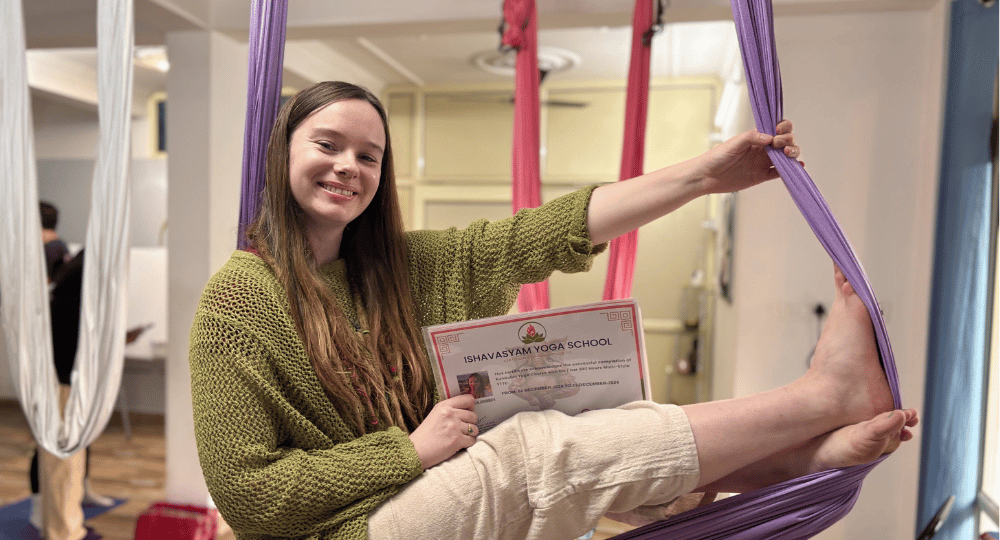
- Receive Certification of Completion: Gain a school-recognized certificate that allows you to share aerial yoga in studios, workshops, and retreats worldwide (note: short course not registered with Yoga Alliance).
- Receive YACEP Certification of Completion: If you are an RYT 200 this course is best for you. You can register the certification with Yoga Alliance USA under YACEP.
Ready to take your yoga practice and teaching skills to new heights?
Contact us today to secure your spot in our 100-Hour Aerial Yoga Teacher Training in Rishikesh and embark on a life-changing journey!
Please Read Carefully.
- * Check-In on 2nd between 11AM – 4PM.
- * Orientation & Opening Ceremony on 2nd.
- * All classes will start on the 3rd at their given time.
- * All Classes will end on the 13th.
- * Exam (Written & Practical) on 13th + Graduation.
- * Farewell & Checkout on 14th by 10:00 AM.
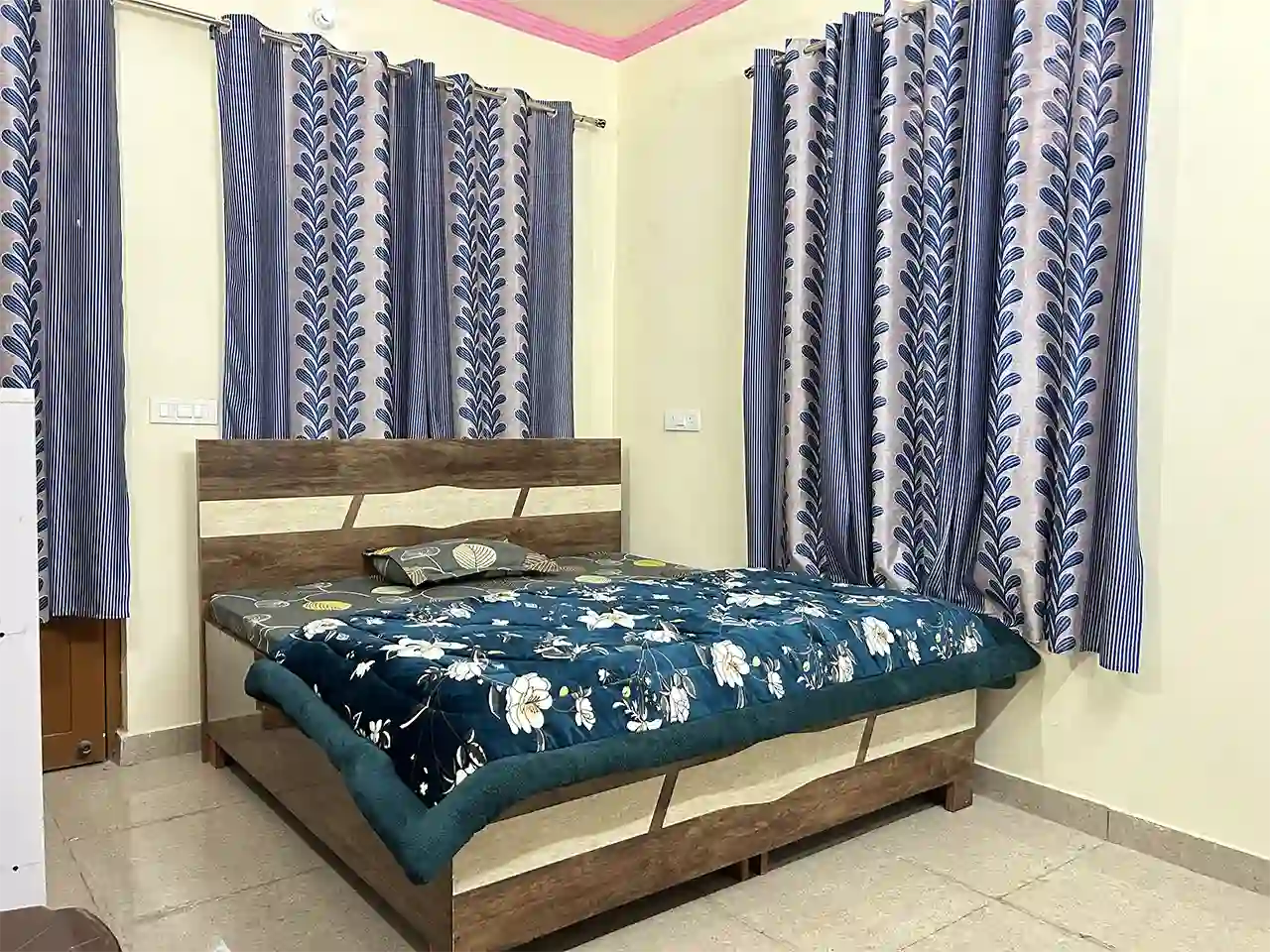
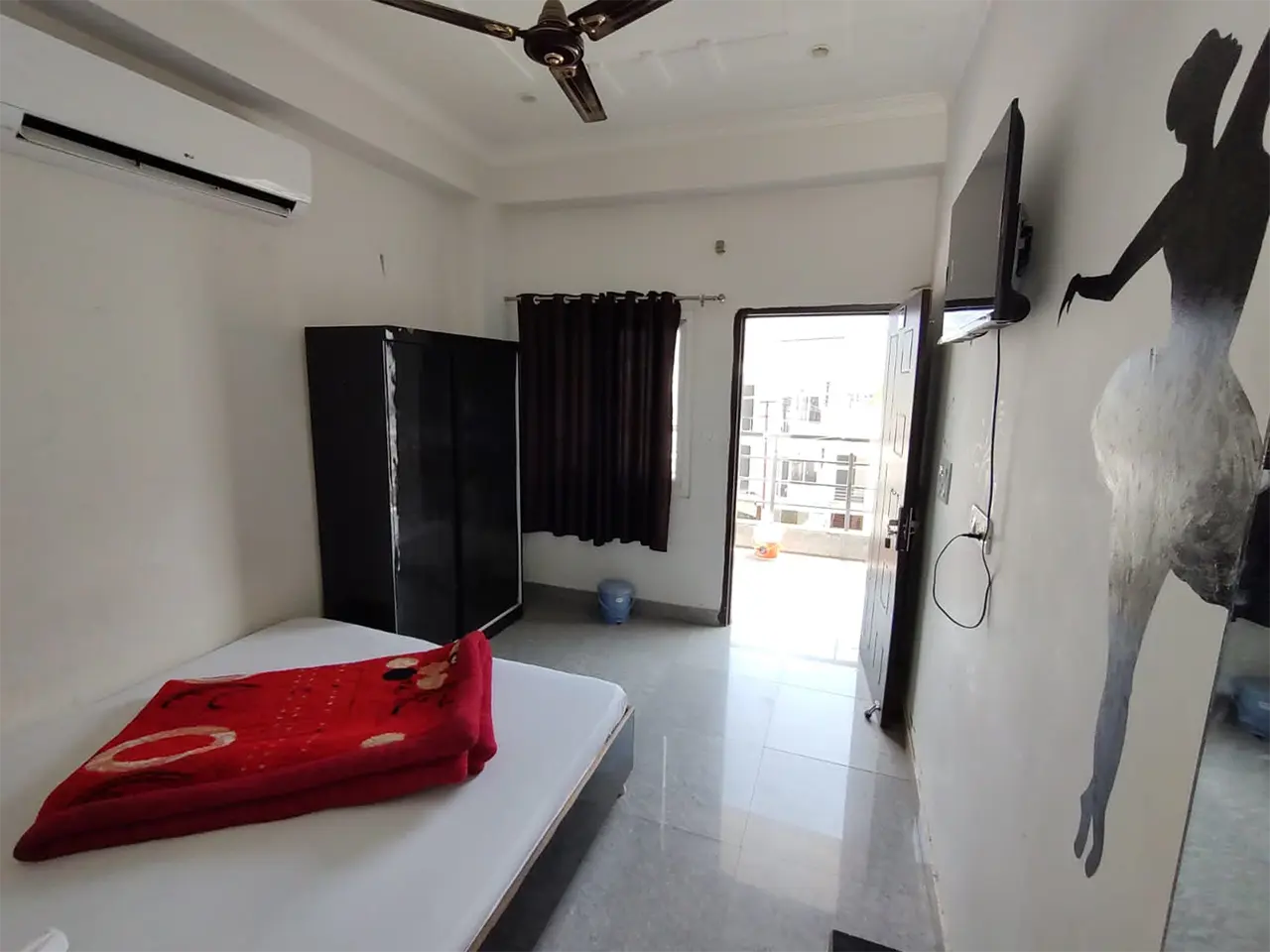
- * AC and room heaters are available upon request at an additional charge.
- * Please read all the School Policies carefully.
- * 100% attendance in all courses is mandatory; uninformed and irrelevant absences will be considered for cancellation of certification.
- ** Pickup or Drop service is only included with Twin Sharing & Private Accommodation participants.
Course Fee : 10 DAYS — 100 HOUR AERIAL YOGA COURSE
|
Payment Details |
|||
| Accom. Type | Total Fees (20% OFF!) |
PayPal Booking ($200) |
|
|---|---|---|---|
| Only Course | $449 | ||
| 3 Sharing Dormitory (Female) | $549 | ||
| 2 Sharing (Same Gender) |
|
||
| Private Accomm. |
|
||
Introduction to Aerial Yoga
What Is Aerial Yoga?
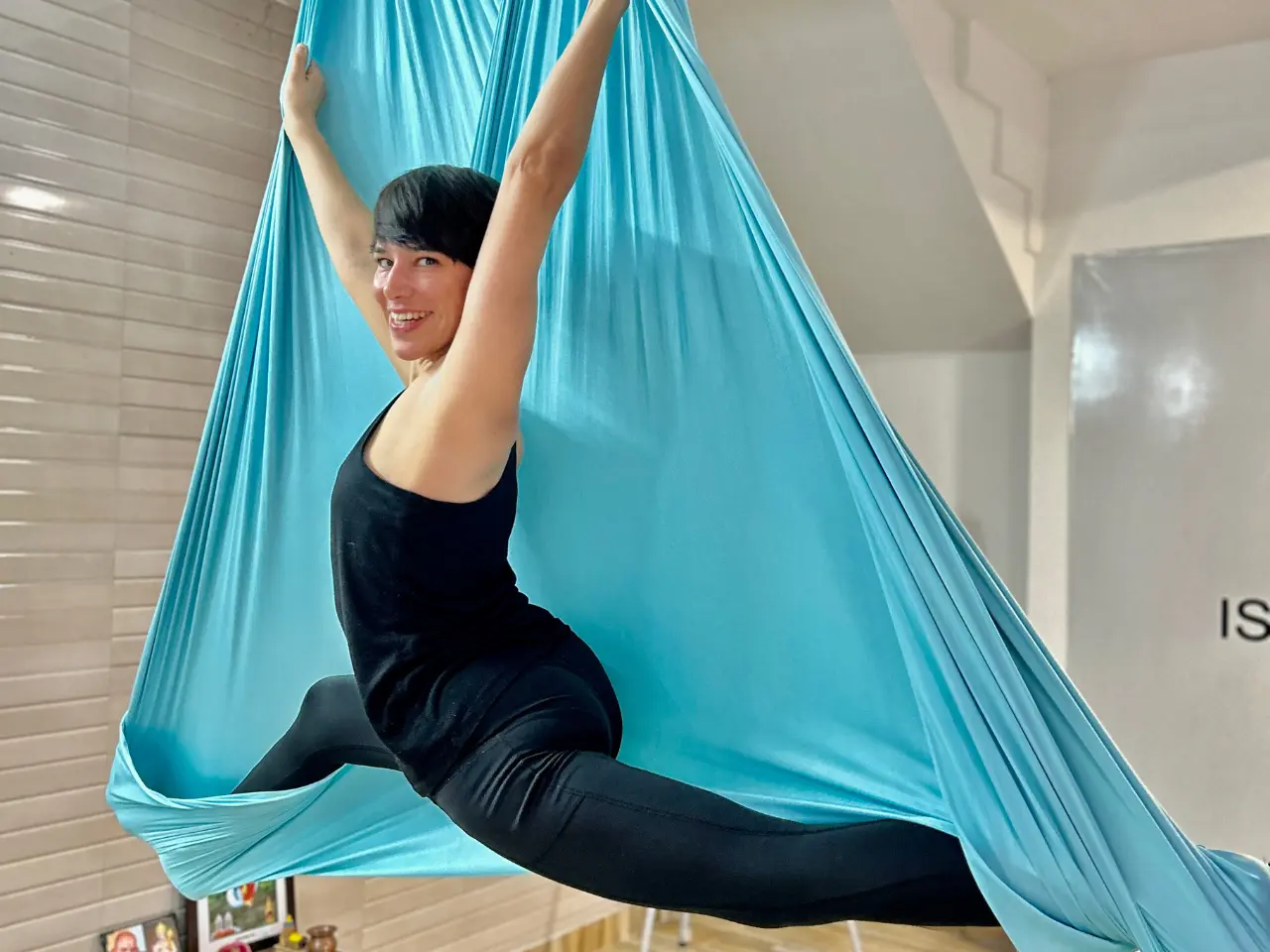
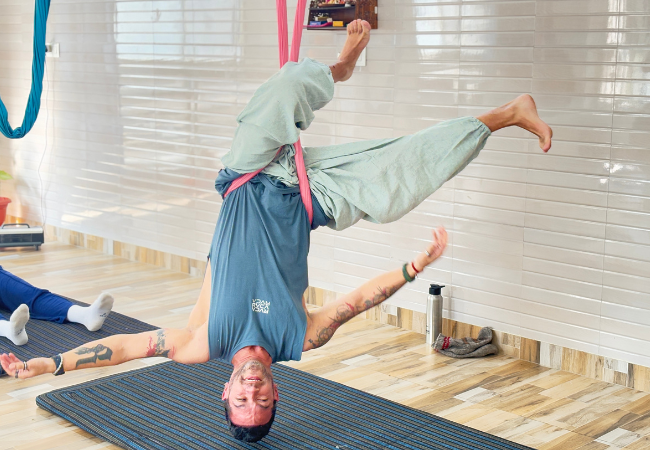
Aerial Yoga is a contemporary yogic discipline that expands the scope of traditional yoga by integrating classical yogic principles with movement in suspension. Using a soft, supportive silk hammock, the practice enables practitioners to experience postures with reduced joint compression, improved alignment, and greater spatial awareness. Unlike mat-based yoga, where gravity constantly loads the joints and spine, aerial yoga strategically redistributes body weight, allowing safer access to inversions, deeper stretches, and refined strength-building without excessive strain.
Rooted in Hatha Yoga principles and informed by modern movement science, aerial yoga evolved as a response to common limitations faced by practitioners worldwide — spinal compression, restricted mobility, fear of inversions, chronic stiffness, and repetitive strain injuries. By suspending the body, the hammock becomes both a prop and a teacher, offering feedback, support, and resistance.
Often referred to as anti-gravity yoga, aerial yoga is not about acrobatics or performance. When practiced authentically, it is a therapeutic and mindful system that enhances proprioception, neuromuscular coordination, and breath regulation. The practice naturally encourages spinal decompression, making it particularly beneficial for individuals dealing with lower back discomfort, postural imbalances, desk-related stiffness, and stress-induced tension.
Aerial yoga, when taught and practiced correctly, solves real problems faced by modern bodies and minds. It restores mobility, supports spinal health, cultivates mental clarity, and reconnects practitioners with a sense of lightness and stability. This is the essence of authentic aerial yoga education — grounded in yoga, informed by science, and applicable across cultures and bodies.
Aerial yoga also resolves one of the most common barriers in yoga practice: fear. Fear of falling, fear of inversions, and fear of injury often limit progress. The hammock provides a controlled and supportive space where trust can be rebuilt — both physically and psychologically. Over time, practitioners develop confidence, body intelligence, and self-reliance.
Come and discover what it means to fly with heart — only at Ishavasyam Yoga School.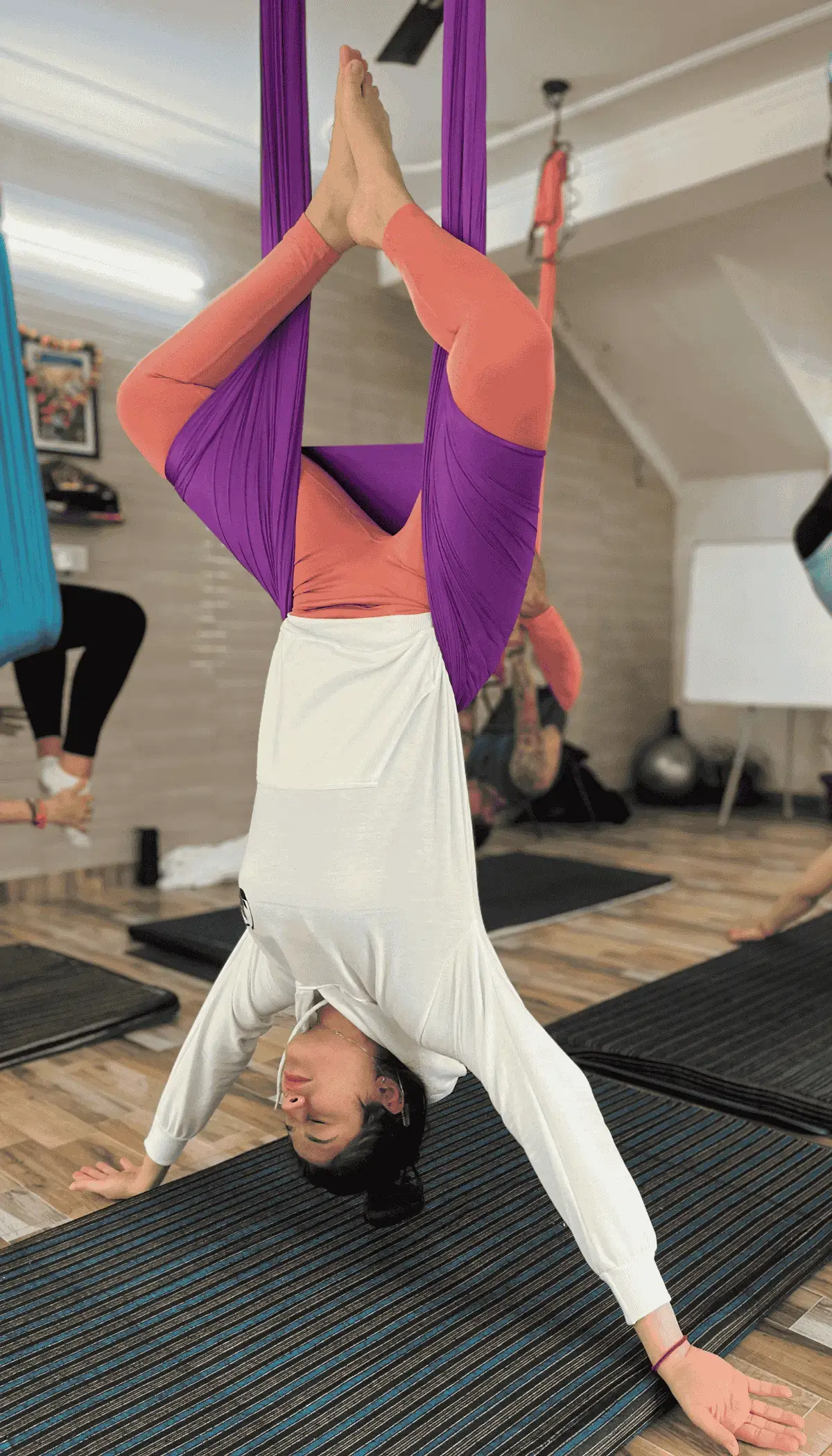

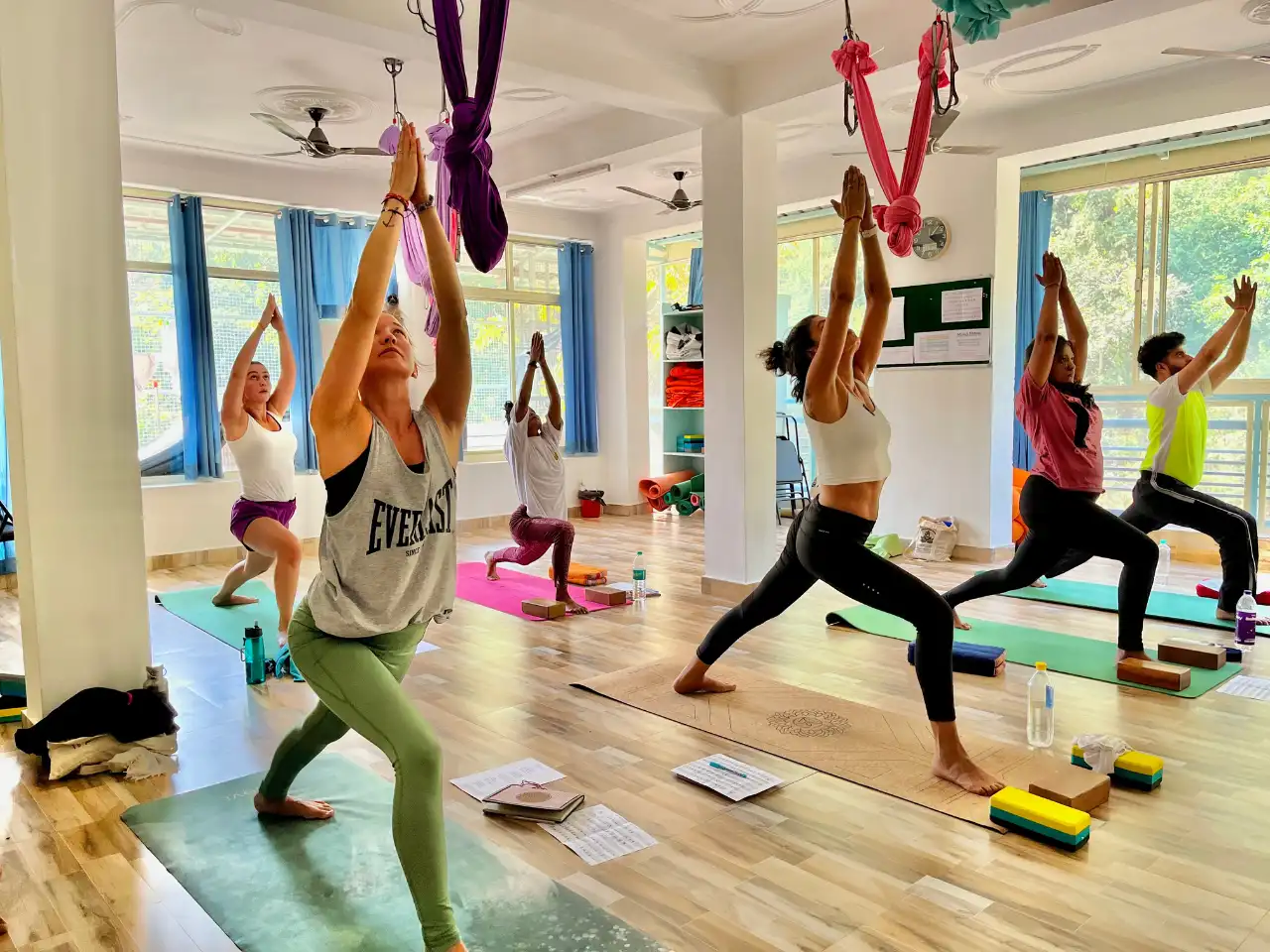
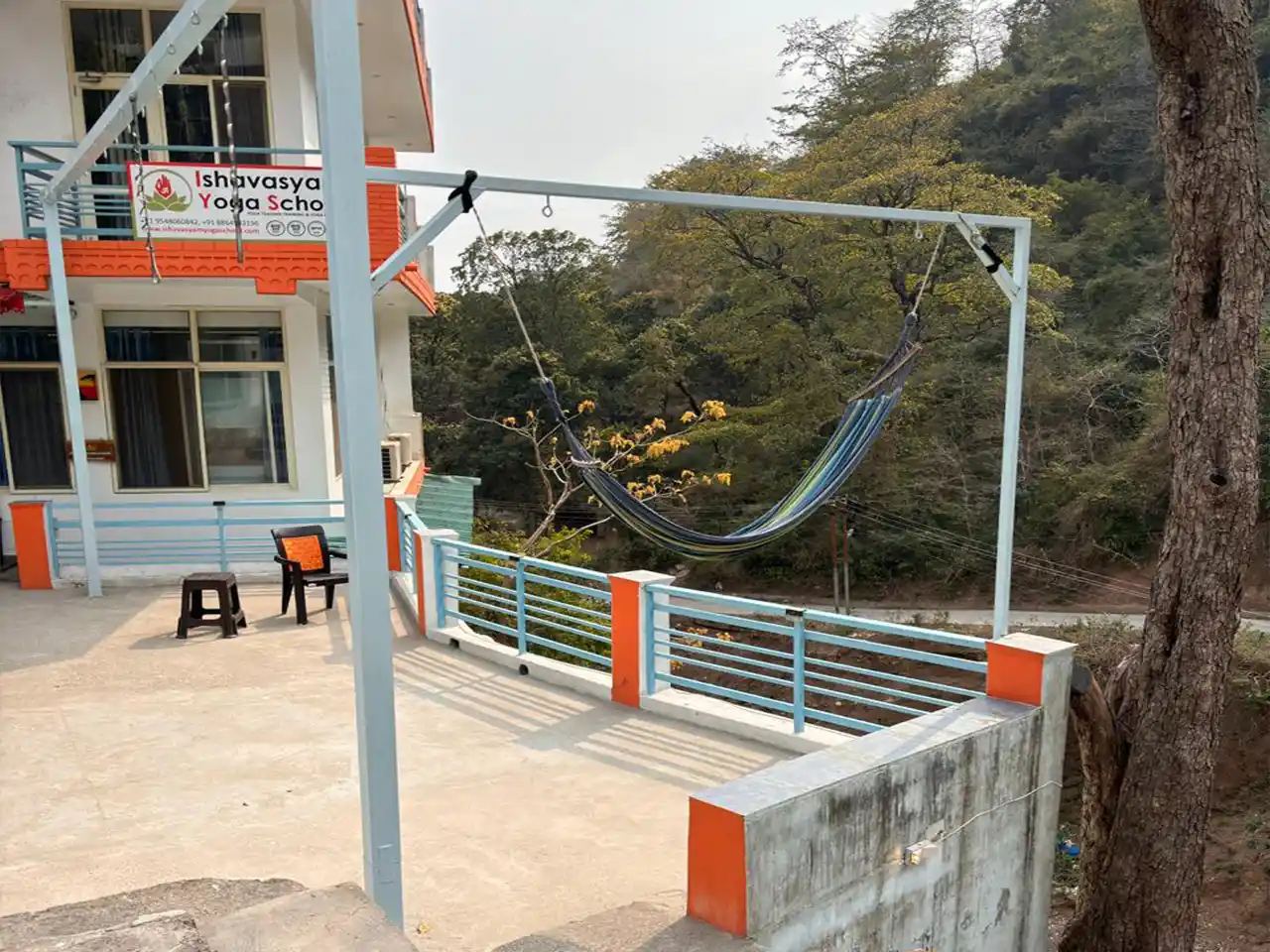
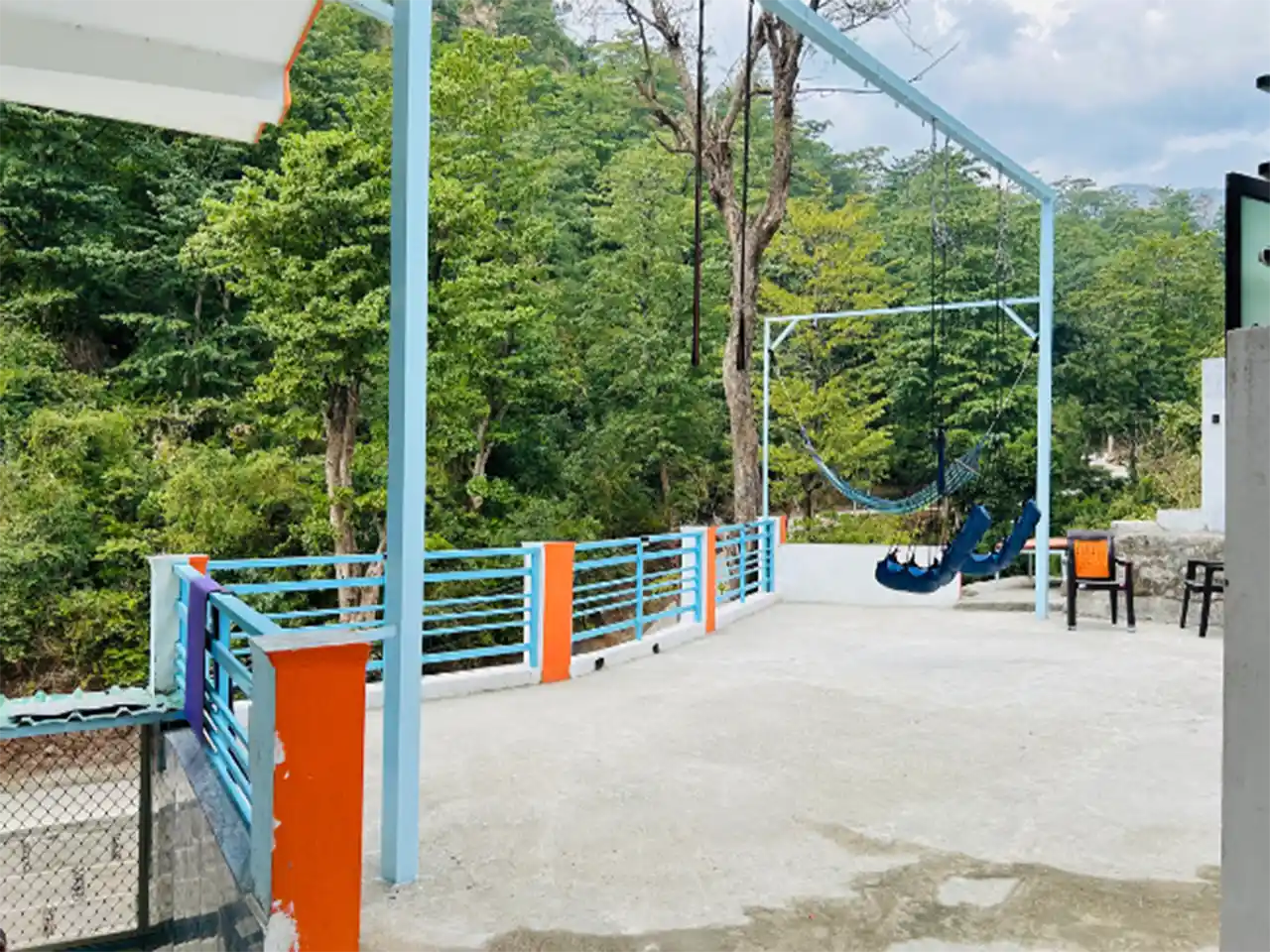

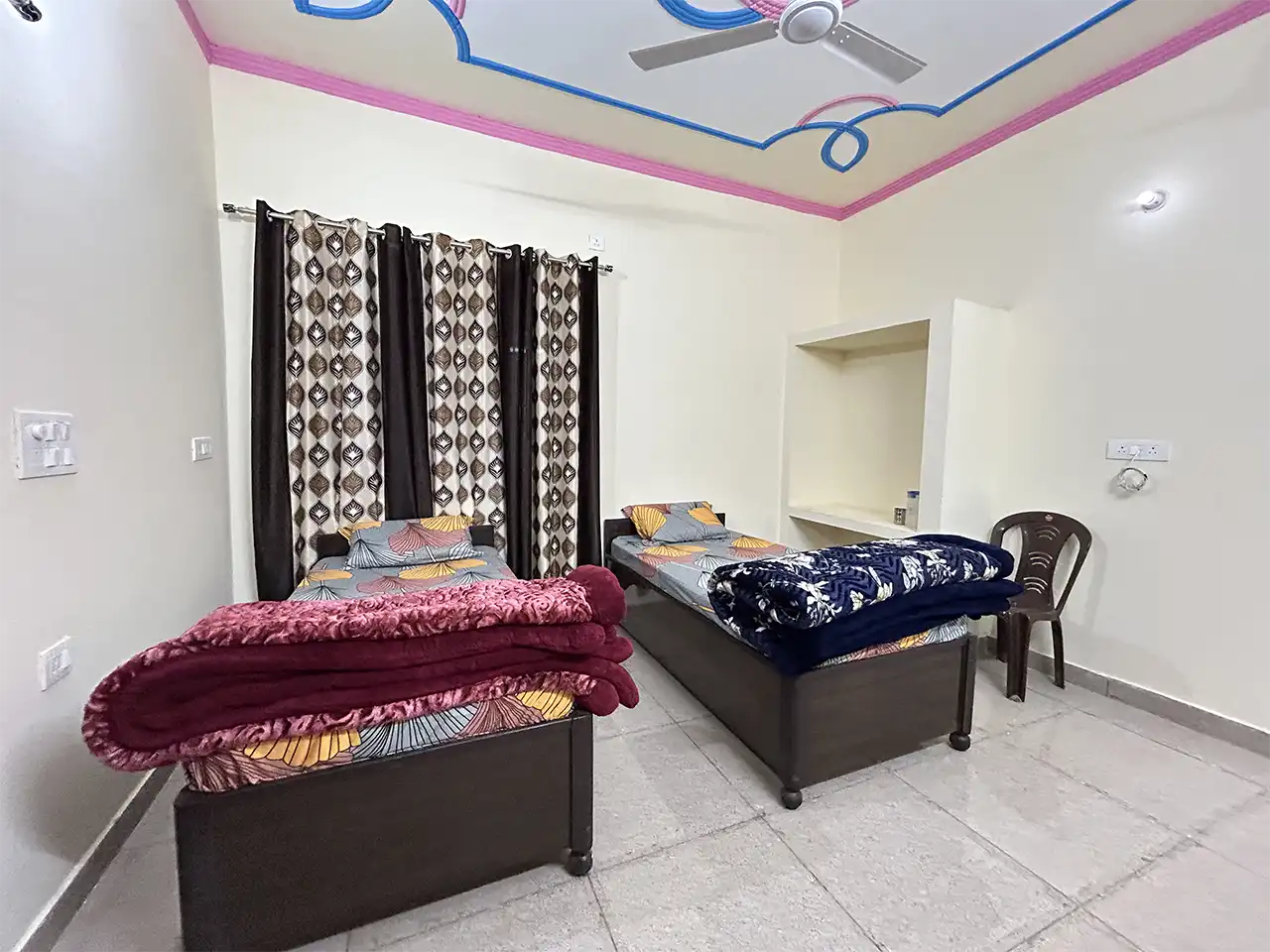
Why Choose our Aerial Yoga Course in Rishikesh?
Choosing an aerial yoga course is not about duration alone; it is about depth, safety, authenticity, and long-term value. The 10 Days / 100-Hour Aerial Yoga Course at Ishavasyam Yoga School is designed for those who want more than a surface-level experience.
The defining strength of this course lies in its holistic approach. Ishavasyam Yoga School is the only institution offering aerial yoga education that is fully integrated with classical yoga knowledge and modern aerial methodology. Students are not only taught how to perform aerial postures, but why they work, how the body responds in suspension, and how to adapt movements intelligently.
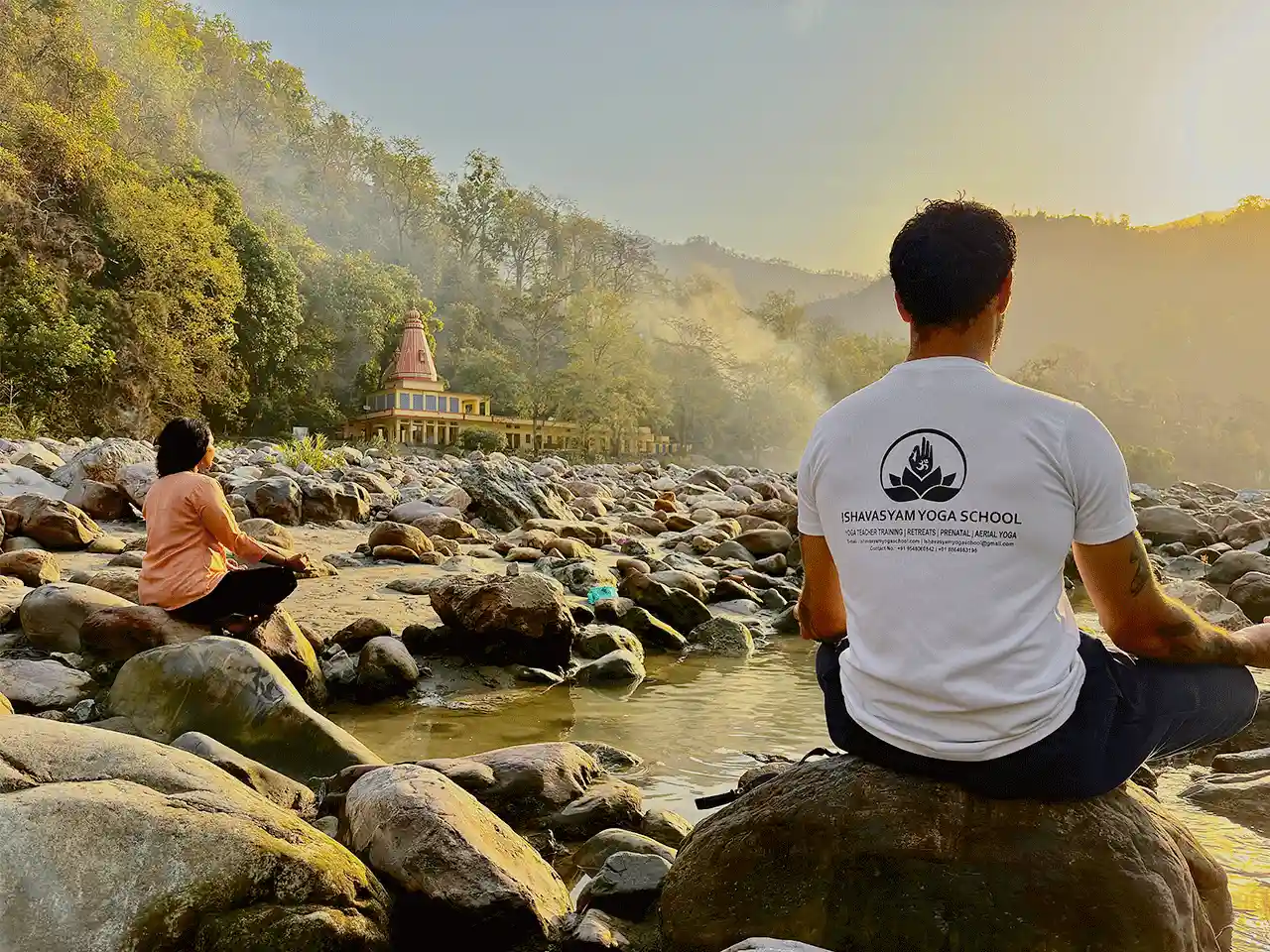
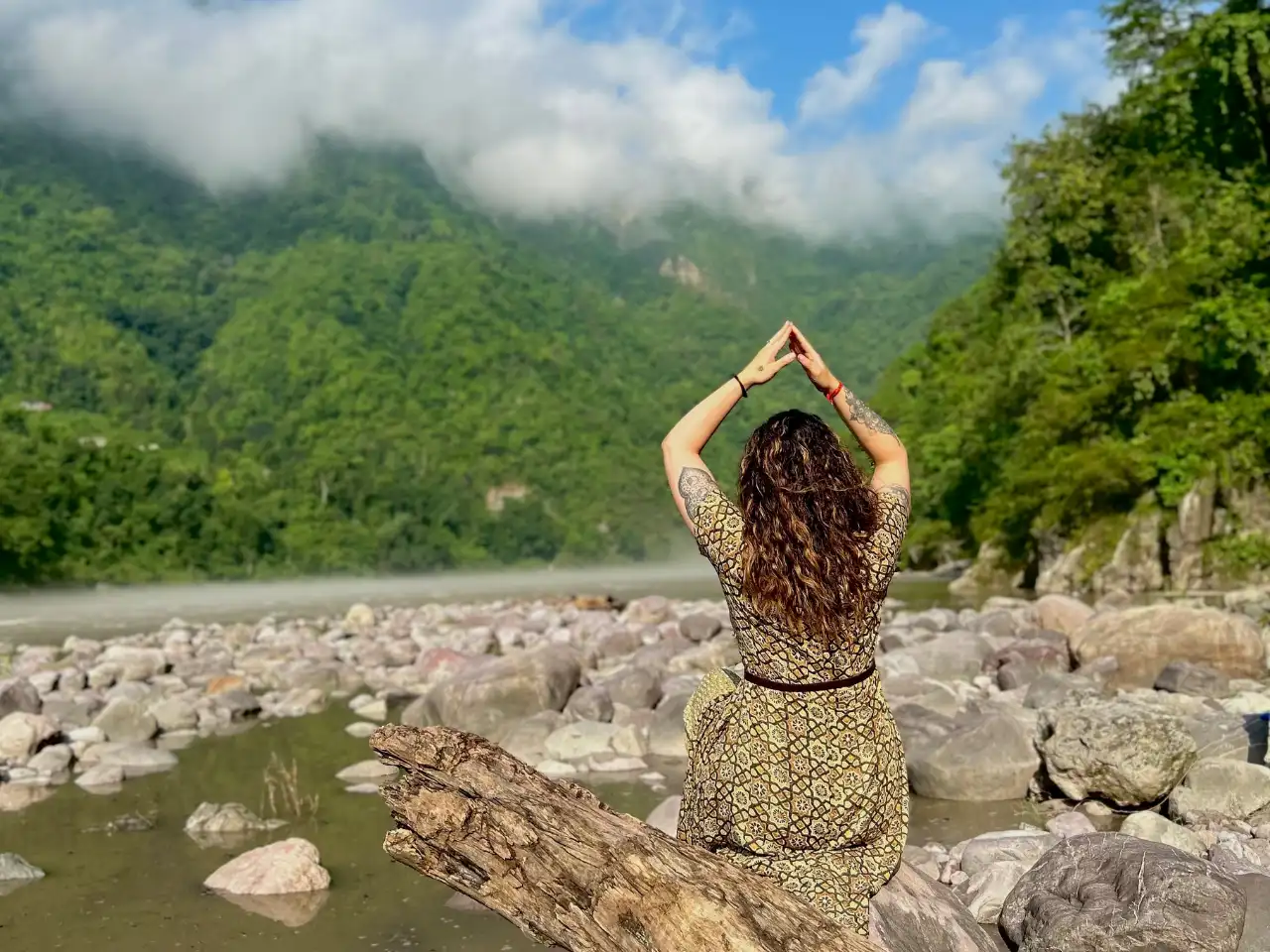
Another reason to choose us is the unique setting — Rishikesh, the Yoga Capital of the World, provides the perfect spiritual backdrop. Surrounded by the Himalayas and the sacred Ganga River, your practice becomes more than physical — it becomes a journey of healing and self-discovery. Add to this our experienced international-level teachers, small batch sizes for personalized attention, and a curriculum enriched with guided meditations, sound healing sessions, and lifestyle Ayurveda wisdom, and you have the most comprehensive aerial yoga program of its kind.
Whether your intention is to deepen your personal practice, overcome fear of inversions, improve spinal health, or lay a strong foundation for teaching aerial yoga, this 10 Days Aerial Yoga Course in Rishikesh offers a complete and grounded pathway.
Arrive as a seeker, return as family.
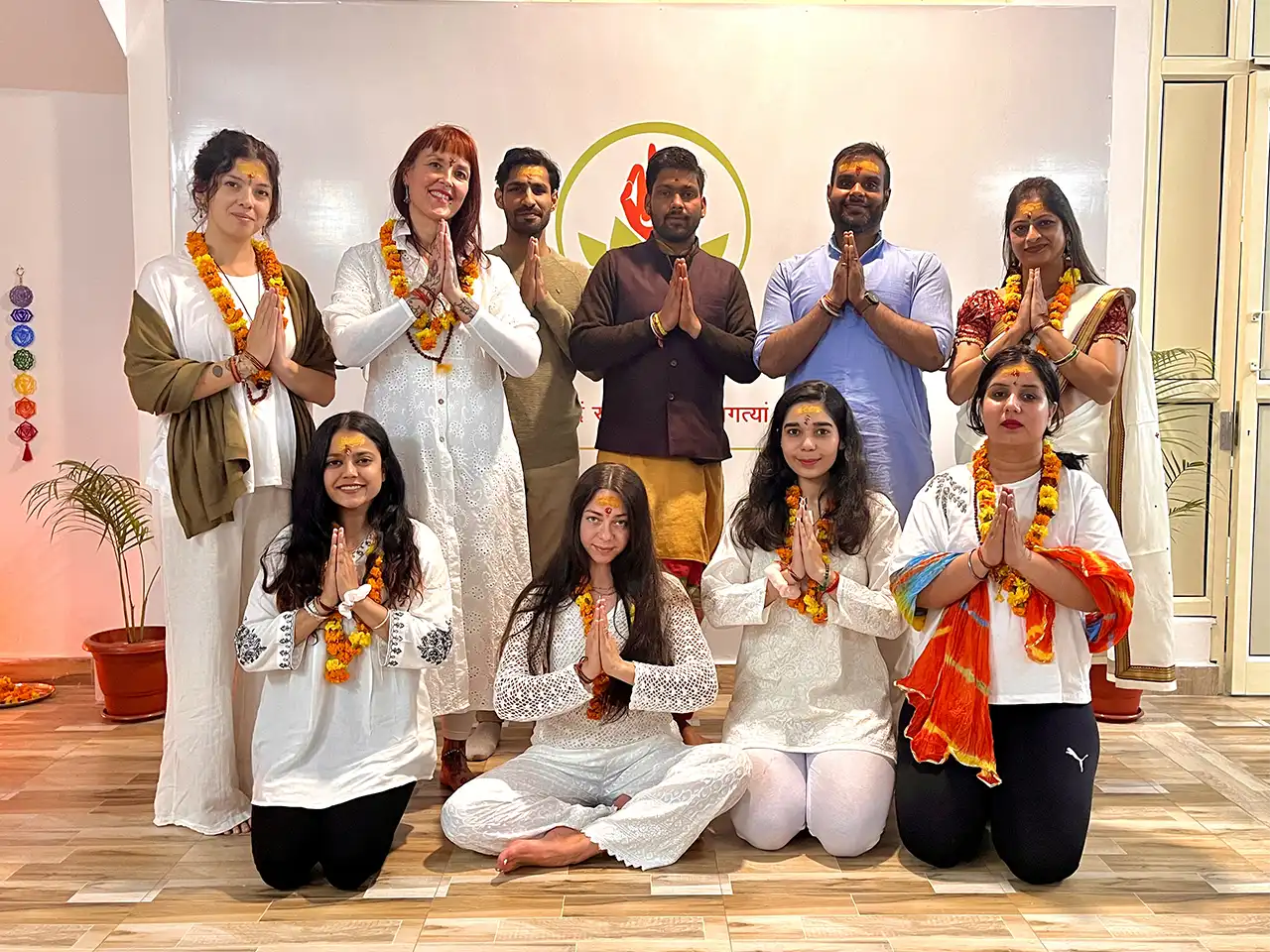
At Ishavasyam Yoga School, we open our hearts and doors to offer not just yoga training, but a sacred home where learning, healing, and transformation flow naturally.
Important Information!
10 Days Aerial Yoga Course (100 Hours)
Highlights
| Daily yoga, meditation, mantra chanting, pranayama, and shatkarma practices |
|---|
| 10 days of Aerial Yoga & Aerial Flow |
| Eligible to register with Yoga Alliance Continuing Program (YACEP) upon completion (*only for RYTs) |
| Daily, 3 times, yogic food and tea |
| Sound Bath Session |
Accommodation
| Check-in Time: 11:00 | Date: 2nd |
|---|
| Check-out Time: 10:00 | Date: 14th |
Skill Level
| Beginner |
|---|
| Intermediate |
Styles
| Yin Yoga |
|---|
| Hatha |
| Ashtanga Vinyasa |
| Aerial Arts / Yoga |
Special Gifts for You
As part of your Aerial Yoga Training Course in Rishikesh, we are delighted to offer you one complimentary session:
🌿 Sound Bath Healing Session — A deeply restorative journey with Tibetan bowls, gongs, and chimes that harmonize body and mind, reduce stress, and elevate your aerial practice.
Living Yoga: Your 10-Day Aerial Yoga Journey
This 10-Day Aerial Yoga Teacher Training in Rishikesh is not designed as a short retreat or a casual workshop. It is a living yoga experience, created to immerse you fully in conscious movement, disciplined practice, breath intelligence, and inner awareness. From the moment you arrive, the structure of the program supports you in stepping away from distraction and into embodied learning.
Beyond learning aerial yoga techniques, these ten days emphasize living yoga as a daily discipline. Each day develops confidence, strength, stability, and self-trust through repetition and mindful progression. As the body adapts to suspension, the mind also learns to let go — of fear, excessive control, and unconscious tension.
Benefits of Aerial Yoga!
- Aerial yoga offers solutions that are increasingly relevant to a global population living with sedentary habits, stress, and physical imbalance.
- Greater flexibility develops naturally as the hammock supports deeper stretches without forcing joints or muscles.
- Spinal relief is one of the most significant benefits. Gentle inversions and traction-based postures allow the spine to decompress, reducing pressure on discs and nerves.
- On a mental and emotional level, aerial yoga enhances focus, reduces anxiety, and cultivates trust. Restorative aerial postures promote deep nervous system regulation, leading to clarity, emotional balance, and improved sleep.
10 Days Aerial Yoga Teacher Training Course
Availability Calendar

| 2026 Dates & Availability | ||
| Month | Dates | Seats Available |
|---|---|---|
| March 2026 | 2nd to 14th | 06 / 07 |
| April 2026 | 2nd to 14th | 03 / 07 |
| May 2026 | 2nd to 14th | 02 / 07 |
| June 2026 | 2nd to 14th | 07 / 07 |
| July 2026 | 2nd to 14th | 07 / 07 |
| August 2026 | 2nd to 14th | 04 / 07 |
| September 2026 | 2nd to 14th | 04 / 07 |
| October 2026 | 2nd to 14th | 05 / 07 |
| November 2026 | 2nd to 14th | 06 / 07 |
| December 2026 | 2nd to 14th | 07 / 07 |
Our Reviews
Explore our fan-favorite courses!
200 Hours Multistyle
(Hatha, Ashtanga & Yin)
Styles
| Yin Yoga |
|---|
| Hatha Yoga |
| Ashtanga Vinyasa |
| Swadhyay |
| Ayurveda & Lifestyle |
200 Hours
(Multistyle + Aerial Yoga)
Styles
| Yin Yoga |
|---|
| Hatha Yoga |
| Ashtanga Vinyasa |
| Aerial Yoga |
| Ayurveda & Lifestyle |
200 Hours
(Multistyle + Kundalini)
Styles
| Yin Yoga |
|---|
| Hatha Yoga |
| Ashtanga Vinyasa |
| Kundalini Tantra |
| Ayurveda & Lifestyle |
COURSE CURRICULUM | 10 DAYS AERIAL YOGA COURSE:
Aerial Yoga
Aerial Yoga in the syllabus introduces students to using the hammock as a prop to deepen flexibility, build strength, and experience yoga postures with support and creativity, enhancing both physical alignment and inner awareness.
Syllabus:
- Sukhasana (Easy pose)
- Vajrasana (Thunder pose)
- Ardha Uttanasana (Half Forward Bend)
- Utthita Ardha Uttanasana (Flat back)
- Ekapada ardha parsvottanasana (One leg lifted/crunch pose)
- Veer Bhadrasana (Warrior pose 3)
- Balasana (Child pose)
- Balasana (Child pose / lifted hip)
- Marjariasana (Cat and cow pose)
- Bhujangasana (Cobra pose)
- Supta vajrasana (Reclined thunderbolt pose)
- Kati chakrasana (Spinal twist)
- Utkatasana (Chair pose)
- Hasthouttan Asana (Raised arm back arch)
- Viman asana (Aeroplane)
- Veerbhadra asana-3 (Warrior pose 3)
- Padmasana (Lotus pose)
- Trikona asana (Front split)
- Ustrasana (Camel pose)
- Dhanurasana (Bow pose)
- Chakrasana (Wheel pose)
- Uttanasana (Forward bending)
- Trikona asana (Triangle pose)
- Adho Mukha svan asana (Downward facing dog)
- Salabh asana (Locust pose)
- Vrischikasana (Scorpion pose)
- Veerbhadra asana (Warrior pose 1)
- Veerbhadra asana (Warrior pose 2)
- Utthita Parsvakonasana (Side angle pose)
- Viparita veerbhadra (Warrior pose variation)
- Utthita hasta padangusthan asana (Big toe pose)
- Parivartit padangusthan asana (Revolved hand to big toe pose)
- Parshvottan Asana (Pyramid pose)
- Ardha chandrasana (Half moon pose)
- Hanuman asana (Full split pose)
- Kapotasana (Pigeon pose)
- Natraj asana (Dancer pose)
- Tadasana (Mountain pose)
- Tree pose (Vriksha asana)
- Padangusthan asana (Big toe pose)
- Nauka Asana (Boat pose)
- Bandhkonasana (Butterfly pose)
- Drop - Bandhkonasana (Inverted butterfly pose)
- Chaturbhuj asana (Square pose)
- Vipareet asavsanchal Asana (Reversed lunge)
- Shavasana (Corpse pose)
- Dhanu baan asana (Bow and arrow pose)
- Sarvangasana (Shoulder stand)
- Inversion (Upside down)
- Reversed trikonasana
- Shirsh asana (Head stand)
- Urdhva mukha svanasana (Upward facing dog)
- Dhanurasana (Bow pose)
- Malasana (Garland pose)
- Hanuman asana (Split pose)
- Flip locust
- Superhero
- Ekpada prapadh Asana (Single foot sitting)
- Sarvangh asana (Shoulder stand)
- Bhujangasana (Cobra pose)
- Vampire pose
- Ardhachandra asana (Half moon pose)
- Viparit badhkon asana (Reversed butterfly pose)
- Ballerina pose
- Seahorse pose
- Butterfly pose
- Halasana (Plough asana)
- Skandasana (Wide-legged squat)
- Yogi pose
- Viparit padmaasana (Inverted lotus)
- Kapot asana (Pigeon pose)
- Padmaasana (Lotus pose)
Hatha & Yin Asana
Hatha Asana — The practice of Haṭha āsanas is not merely physical exercise but a tool to harmonise the body (śarīra), breath (prāṇa), and mind (manas). It purifies the body, strengthens the nervous system, opens the energy channels (nāḍīs), and prepares the practitioner for deeper practices like prāṇāyāma and meditation.
-
Syllabus:
- Surya Namaskar
- Pawanmuktasana series 1
- Pawanmuktasana series 2
- Chandra Namaskar (Moon salutation)
- Tadasana (palm tree pose)
- Triyak tadasana (swaying palm tree pose)
- Trikonasana (triangle pose)
- Parivirtatrikon asana – revolving triangle pose
- Virabhadrasana 1 – warrior 1
- Virabhadrasana 2 – warrior 2
- Virabhadrasana 3 – warrior 3
- Ardha Chandrasana – Half moon pose
- Vrikshasana – tree pose
- Parvatasana – mountain pose
- Adho mukha svanasana – downward facing dog
- Kati chakrasana – waist rotating pose
- Garudasana – eagle pose
- Baddha Konasana – bound angle pose
Ashtanga Vinyasa
Ashtanga Vinyasa is a dynamic system of yoga that combines asana (posture), pranayama (breath control), and vinyasa (breath-synchronized movement) in a structured and flowing sequence. Rooted in the ancient teachings of Patanjali's Ashtanga (eight-limbed) Yoga, this style was codified and popularized in the modern era by Sri T. Krishnamacharya and his student Sri K. Pattabhi Jois in Mysore, India.
-
Syllabus:
- Surya Namaskar (Alignment, Drishti, Adjustment, Options)
- Surya Namaskar A
- Chandra Namaskar (Moon Salutation)
- Surya Namaskar B
- Padangusthasana
- Padahasthasana
- Utthita Trikonasana
- Parivrtta Trikonasana
- Utthita Parsvakonasana
- Parivrtta Parsvakonasana
- Prasarita Padottanasana A, B, C, D
- Parsvottanasana
- Eka Pada Padangusthasana A, B, C, D
- Ubhaya Padangusthasana
- Urdhva Mukha Paschimottanasana
- Setu Bandhasana
- Urdhva Dhanurasana
- Salamba Sarvangasana
- Halasana
- Karnapidasana
- Urdhva Pindasana
- Urdhva Padmasana
- Sirsasana
- Urdhva Dandasana
- Baddha Padmasana
- Yogimudra
- Uplutih
- Savasana
Pranayama & Meditation
Pranayama — Derived from the words prana (vital life force) and ayama (extension or control), Pranayama refers to the conscious regulation and expansion of the vital energy through disciplined breath control.
Meditation is the state of meditative absorption, where the mind becomes still, the senses withdraw inward, and the practitioner experiences deeper states of awareness, inner peace, and union with the Self.
-
Syllabus:
- Definition of Pranayama
- Four Aspects of Pranayama
- Sectional Breathings
- Need of Breath
- Natural Breathing
- Chandra Bhedi Pranayama (Moon piercing breath)
- Surya Bhedi Pranayama (Sun piercing breath)
- Nadi Shodhana Pranayama (Alternate nostril breath)
- Ujjayi Pranayama (Ocean breath)
- Sheetali & Sheetkari Pranayama (Cooling breath)
- Bhastrika
- Shatkarmas (Cleansings)
- Tri Doshas
Pranayama
Meditation
- Purpose of life & its dimensions
- Introduction to meditation
- Types of meditation
- Trataka (concentrated gazing)
- Yoga Nidra (psychic sleep)
- AUM / OM meditation
- Chakra meditation
- Mantra meditation
- Mindfulness meditation
Yoga Philosophy & Life Management
Yoga Philosophy offers a deep understanding of the ancient yogic texts, principles, and ethics, helping students connect the practice on the mat with a meaningful, conscious lifestyle off the mat.
-
Syllabus:
- Three Gunas
- Cause & types of pain
- The monkey mind
- Sanatana Dharma
- Vedas
- The Introduction Six Systems of Indian Philosophy
- Jnana Yoga
- Bhakti Yoga
- Karma Yoga
- Mantra Yoga
- Hatha Yoga
- Raja Yoga
Yoga Philosophy
Applied Yoga Anatomy & Bio Mechanics
Applied Yoga Anatomy & Biomechanics is the conscious integration of ancient yogic wisdom with modern anatomical science and movement mechanics. It empowers practitioners and teachers to understand the body's structure, movement patterns, and energy flow in relation to yogic practices.-
Syllabus:
- Functional anatomy of the skeletal, muscular, and nervous systems in yoga
- Biomechanical principles behind alignment, balance, and movement
- Joint range of motion and stability during static and dynamic postures
- Postural assessment and intelligent modifications for all body types
- Yoga therapy insights to address physical imbalances and discomfort
Adjustment & Alignment and Bio Mechanics
Adjustment & Alignment and Bio Mechanics is the art and science of guiding students safely and effectively into postures using hands-on corrections, verbal cues, and a deep understanding of how the body moves. It bridges the gap between traditional yogic practice and modern movement science to help teachers build safer, more intelligent classes.-
Syllabus:
- Principles of hands-on adjustment — when, how, and when not to touch
- Verbal and visual cueing techniques for precise alignment correction
- Biomechanical analysis of key standing, seated, forward, and backbend postures
- Common misalignments and their root causes in different body types
- Safe adjustment protocols for hypermobile, injured, and beginner students
FAQs — 10 Days Aerial Yoga Teacher Training, Rishikesh
No prior aerial yoga experience is required. The course is designed to welcome both beginners and intermediate practitioners. A reasonable level of physical fitness is recommended, but no specific yoga certification or aerial background is needed to enroll.
Yes. If you are already a Registered Yoga Teacher (RYT 200 or above) with Yoga Alliance USA, you can register this 100-hour certification as Continuing Education (YACEP) credits upon successful completion. This makes it an excellent professional development investment for existing yoga teachers looking to expand their offering.
Check-in is on the 2nd of each month between 11 AM and 4 PM. Orientation and opening ceremony take place on the 2nd. All classes begin on the 3rd. Classes conclude on the 13th. The written and practical exam plus graduation ceremony are held on the 13th. Farewell and checkout is on the 14th by 10:00 AM.
The course fee covers all aerial yoga sessions, Hatha and Ashtanga Vinyasa classes, pranayama and meditation, a complimentary sound bath healing session, course manual, and certification. Accommodation packages also include 3 yogic meals per day plus tea and room accommodation as specified. The course-only package covers training and meals during class hours.
The nearest airport is Jolly Grant Airport, Dehradun (approximately 35 km / 50 minutes). The nearest railway station is Haridwar Junction (approximately 25 km / 40 minutes). Buses and shared taxis also run from Delhi (6–7 hours). Airport and station pickup is included for Twin Sharing and Private Accommodation participants. Please coordinate your arrival time with us in advance.
Upon successful completion of all classes, the written examination, and the practical assessment, you will receive a Certificate of Completion in Aerial Yoga Teacher Training issued by Ishavasyam Yoga School. For RYT 200+ holders, this can be registered as YACEP continuing education credits with Yoga Alliance USA. Please note this short course is not independently registered with Yoga Alliance.
50 Hours 6 Days Aerial Yoga Course
Daily Schedule

| Time | Class |
|---|---|
| 05:15 AM - 06:15 AM | Pranyama & Meditation Practice (shatkarma) |
| 06:15 AM - 07:45 AM | Asana Class (Hatha Yoga / Yin Yoga) |
| 07:45 AM - 08:30 AM | Breakfast |
| 08:30 AM - 09:30 AM | Applied Yoga Anatomy & Bio Mechanics |
| 10:00 AM - 11:30 AM | Aerial Asana Practice |
| 11:30 AM - 1:30 PM | Lunch |
| 02:45 PM -04:00 PM | Aerial Sequence |
| 03:45 PM - 4:15 PM | Tea Break |
| 04:15 PM - 05:30 PM | Yog Philosophy |
| 05:45 PM - 07:15 PM | Ashtanga Vinyasa / Adjustment & Alignment (Wed. & Sat.) |
| 07:15 PM - 8:00 PM | Dinner |
| 10:00 PM | Lights Off |
*This is a tentative schedule for yoga teacher training course, and can be changed.